 Storm tore your screen?
 Don't see your street?
Screening · Gainesville & Alachua County, FL
Screen Wall Upgrades in Gainesville, FL
Standard 18/14 mesh is a fine default, but it is not right for every wall. No-see-um, pet-resistant, privacy and solar screens each fix a specific problem, and each has a cost. We help you put the right mesh on the right wall.
Screen Wall Upgrades in Gainesville, FL That Solve a Real Problem
Every specialty screen exists because standard mesh falls short somewhere. Tiny biting gnats come straight through it. Dogs push through it. Neighbors can see through it. The afternoon sun pours through it onto the deck. Each upgrade addresses one of those problems, and each gives something up, usually a bit of airflow, a bit of visibility or a bit of money.
The best approach is rarely to put one premium screen on the whole cage. A typical Gainesville yard might want no-see-um mesh on the wall facing the woods, pet screen along the bottom row by the back door, solar screen on the west wall and plain 18/14 everywhere else. Mixing meshes wall by wall gets most of the benefit for a fraction of the cost of upgrading everything.
Gainesville Screen Upgrade Prices Per Panel
Upgraded screen typically adds $15 to $45 per panel over standard 18/14 charcoal. The upgrade is cheapest when it is done during a full rescreen or panel replacement, because the labor of stripping and rolling the panel is already being paid for. Swapping good standard screen for an upgrade costs the full panel price.
| Job | Typical range | What moves the price |
|---|---|---|
| Standard 18/14 charcoal panel | $65 – $150 | Panel size and height |
| 20/20 no-see-um upgrade | +$15 – $30 per panel | Number of walls, roof or walls only |
| Heavier 17/14 fiberglass upgrade | +$15 – $30 per panel | Panel count, often roof bays under trees |
| Pet-resistant polyester upgrade | +$25 – $45 per panel | Lower panels only or full walls |
| Privacy or solar screen upgrade | +$25 – $45 per panel | Product, openness, west or street-facing walls |
| Full cage rescreen with mixed meshes | $1,800 – $5,500 plus upgrades | Cage size and how many panels are upgraded |
If your cage is due for a full pool cage rescreening anyway, that is the cheapest moment to choose upgrades. If the screen is still in good shape, it often makes sense to upgrade only the panels that are causing trouble now, as part of a screen panel replacement visit.
No-See-Um Screen for Gainesville Pool Cages Near Woods and Water
No-see-ums are tiny biting midges, small enough to pass through standard 18/14 mesh. They are worst at dawn and dusk and on still, humid evenings, and they are common near marshes, creeks and wooded lowlands. Plenty of Gainesville yards back up to exactly that kind of ground, from the wetlands and creeks on the west side of town to wooded conservation edges throughout the county.
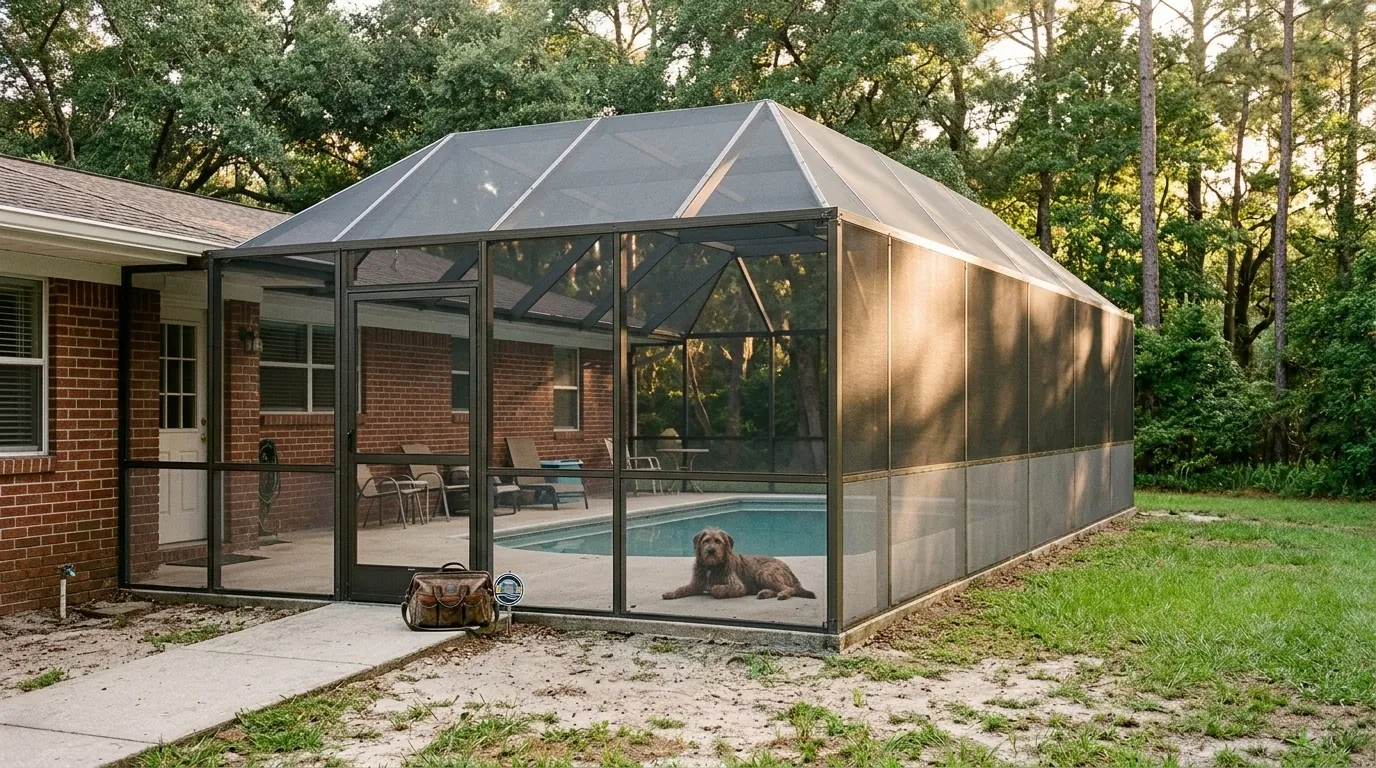
A 20/20 no-see-um mesh has a tighter weave, with 20 strands per inch each way instead of 18 by 14. That small change in the grid closes the openings enough to stop most of these insects. The trade-offs are modest: a little less air moves through, and the screen looks very slightly darker from inside. Most homeowners who have been bitten on their own pool deck feel that is a fair trade. Putting no-see-um mesh only on the walls facing the woods or water keeps the cost down and the breeze up on the other sides.
Heavier 17/14 fiberglass
A 17/14 mesh uses a slightly thicker fiberglass strand than standard 18/14. It is a little more resistant to tears from falling twigs and acorns, which makes it a reasonable choice for roof bays under heavy oak canopy. It is not a true pet screen. Claws will still get through fiberglass of any weight with enough effort.
Pet Screen Upgrades for Gainesville Lanais and Pool Cages
Pet-resistant screen is a vinyl-coated polyester mesh woven much heavier than fiberglass. It resists tearing and puncturing from dogs and cats that paw, push or lean on the walls. It is also a sensible choice anywhere kids play near the screen or where pool toys and chairs bump into the walls.
The cost is visibility and price. Pet screen is noticeably thicker, so the view through it is less clear, and it costs more per panel. Most owners only put it on the lowest row of panels, below the chair rail, where paws and noses actually reach. Depending on the channel, a thicker mesh may also need a smaller spline than the standard size to seat properly, which is one reason it is worth having it installed by someone who checks the fit panel by panel.
Privacy and Solar Screen Wall Upgrades in Alachua County
Privacy screen and solar screen are both heavier, denser meshes, but they solve different problems. Privacy panels are usually a vinyl-laminated fiberglass meant for the lower walls of a cage. They block sightlines from a neighbor's yard or a nearby street and help keep blowing dirt and grass clippings off the pool deck. They are made for vertical walls, not roof bays.
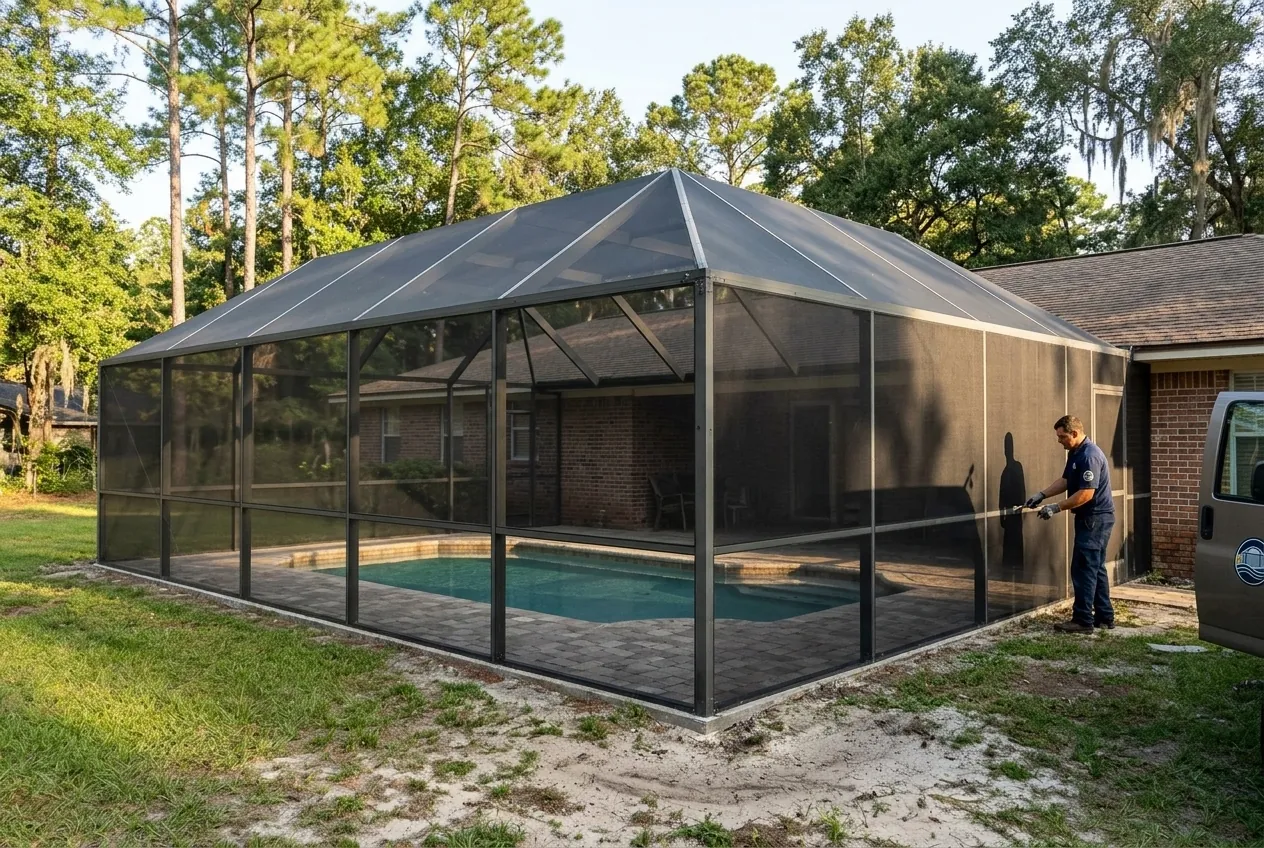
Solar screens are rated by how much of the sun's heat and glare they block, which varies by product. They are most useful on the west and south walls of a cage or lanai, where the afternoon sun makes the deck too hot to use. Because they block more light, they also make the cage darker, and they move less air. Using them on just the one or two walls that bake in the afternoon usually gives the best balance.
One practical note on both: denser screens catch more wind. A wall of heavy privacy or solar mesh behaves a little more like a sail than open 18/14 fiberglass, which puts more load on the frame in a strong gust. On a sound cage with tight braces and cables, a few upgraded panels are not a concern. On an older cage with loose fasteners or a cable that has lost tension, we would fix the frame first, and we will point out anything we see before you commit to heavier screen.
HOA rules on screen color and privacy panels
Before ordering privacy or colored screen, check your community's architectural guidelines. Planned neighborhoods such as Haile Plantation and Brywood may have rules about how enclosures look from the street or from common areas, and some associations specify charcoal or black screen. We can provide product names, colors and a panel map for your application. In more rural parts of the county, such as around Archer, deed restrictions are less common, but it never hurts to look.
Screen Wall Upgrades Gainesville FL Homeowners Ask About
The most common question is whether an upgrade is worth it. If the problem is real and specific, like bites on the deck at dusk or a dog who has already gone through the screen twice, the answer is usually yes for the walls involved. If the goal is just a nicer cage, standard 18/14 charcoal mesh in good condition is hard to beat on clarity and airflow.
The second question is how long upgraded screens last. Every mesh in a Florida back yard is fighting the same sun. Vinyl-coated polyester pet and solar screens are generally tougher than fiberglass, but they still fade and stiffen over time, and the spline holding them in wears out at the same rate as any other spline. Plan on the same kind of inspection schedule: a look at the roof and corners every spring, and a fix to any loose panel before it has a chance to flap and tear.
Our blog post on pool cage screen types explained walks through each option with more detail on weave, strength and visibility. To figure out which walls need which mesh, the easiest step is a free walk-through. Request one from the estimate form, and mention which problems you are trying to solve. Screen upgrades are part of our pool cage repair and rescreening work around Gainesville.
Screen Wall Upgrades Gainesville Questions
Straight answers before you call.
Upgraded screen usually adds $15 to $45 per panel over standard 18/14 charcoal mesh. No-see-um mesh is at the lower end of that range, while pet-resistant, privacy and solar screens are toward the upper end. Upgrades cost least when done during a rescreen.
It reduces airflow a little because the weave is tighter. Most homeowners near wooded lots or water feel the trade is worth it. Putting it only on the walls facing the woods or water keeps more breeze on the other sides.
No. A 17/14 mesh is a heavier fiberglass that stands up a bit better to falling debris. True pet-resistant screen is a much thicker vinyl-coated polyester that resists claws and pushing. Fiberglass of any weight will eventually tear under a determined dog.
Privacy panels are made for vertical walls, usually the lower panels, not roof bays. For shade overhead, a solar screen rated for the application is the usual choice. We will tell you which products suit which part of the cage.
It depends on your association. Some communities specify screen color or limit how enclosures look from the street or common areas. Check your architectural guidelines first. We can supply product names, colors and a panel map for an application.
Yes, and that is usually the smartest approach. Put no-see-um mesh on the wall facing the woods, pet screen on the bottom row near the door, solar on the west wall and standard mesh everywhere else.
More Gainesville Pool Cage Services
Other work we handle on the same visit.
Pool Cage Rescreening
Full cage rescreens with new spline, panel by panel.
Screen Panel Replacement
Torn or bowed panels replaced without a full rescreen.
Lanai & Patio Rescreening
Screen rooms, porches and patios rescreened.
Pool Cage Frame Repair
Bent beams, loose braces, kick plates and gutters fixed.
Screen Door Repair
Doors, closers, hinges and latches repaired or replaced.
Storm Damage Pool Cage Repair
Wind and fallen-limb damage documented and repaired.
Pool Cage Painting & Cleaning
Frames washed and repainted, mildew gone.
Screen Wall Upgrades Matched to Each Wall
Right mesh, right wall. No overspending.